


A War on Paper
by Spoonman
Part 1 – The Open
Bitcoin’s story is one of explosive success against the odds. From a cypherpunk experiment to a multi-trillion-dollar asset, it has survived government bans, exchange collapses, and relentless media attacks, moving from strength to strength on the back of its code, its culture, and its refusal to compromise. It worked because it solved a problem no one else could: money without masters, value you can hold without permission.
But success at this scale invites dangerous rivals; nation states and global power structures that would still very much like to see Bitcoin fail its mission. In fact, Bitcoiners have long anticipated a final confrontation: a clash between the permissionless, scarce nature of Bitcoin and the debasement and surveillance of the fiat system with its central banks and Wall Street champions. That confrontation, however, did not arrive in the way we expected.
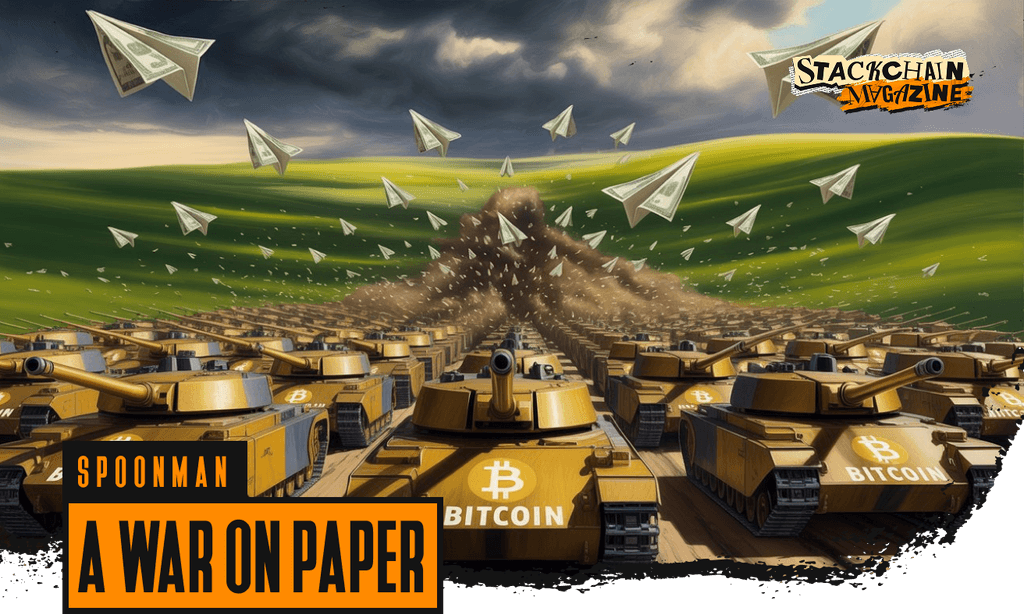
Instead of a bombastic, open assault, the fiat system brought capital and legitimacy to assist Bitcoin’s rise to world reserve status. They also, however, brought a world class savvy in hijacking narratives and creating faux-heroes, not in our image but theirs. Paper Bitcoin was introduced: financial instruments that track Bitcoin’s price without delivering the asset itself, injecting a “trust us” serum into Bitcoin’s veins. The deal? Greater returns but no ownership — leveraged “exposure” to Bitcoin, held in paper IOUs instead of private keys.
The challenge is clear, but meeting it starts with remembering who we are. Bitcoin’s defense has never been just code and hash rate; it has been the ethos that shaped it, the culture that refused compromise, and the people who understood exactly what they were building. As in any battle, the first move is to know yourself — to return to the roots that made victory possible in the first place.
Part 2 – The Roots
If the challenge ahead is to be understood, it begins with remembering where Bitcoin came from. Some speak of it as if it arrived from a clear blue sky, an immaculate conception. Others, somewhat more coherently, present it as the invention of a single genius working in isolation. In truth, it was the product of decades of technological advocacy by those who refused to accept that a digital era would necessarily be anathema to the free man.
The first major threat came in the Crypto Wars of the 1990s. Encryption was declared a weapon, its export restricted like missiles or bombs, as the U.S. government pushed the “Clipper Chip”, a mandatory backdoor for all communications. In stepped Phil Zimmerman, publishing “PGP” software that put military-grade privacy in the public’s hands. U.S. federal prosecutors went after him with ferocity, the message from Washington being clear: privacy was for the state, not the people.
But cypherpunks weren’t asking for permission. They mirrored code across borders, printed PGP’s source on T-shirts, daring the government to arrest them for “trafficking munitions”. Their defense came in the form of the First Amendment: that not only was privacy a right worth fighting for, but that math is protected speech. Against the most powerful government on Earth, they won, laying the foundation for the free internet that followed, the open-source ethos, and the culture that would one day give birth to Bitcoin.
We would see many experiments follow. David Chaum’s DigiCash pioneered anonymous digital money. Adam Back’s Hashcash introduced proof-of-work to counter spam. Nick Szabo’s Bit Gold explored chains of proof-of-work to create scarcity, while Wei Dai’s b-money described decentralized consensus enforced by a community of peers. Then came Satoshi’s breakthrough in 2009, the solution to the Byzantine Generals Problem — Bitcoin. Its first block carried a headline — “The Times 03/Jan/2009 Chancellor on brink of second bailout for banks.” — a shot at the heart of fiat profligacy.
Bitcoin’s roots remind us what freedom in the digital age looks like. But every advance in sovereignty has been met with a countermeasure. Today, the pressures have only multiplied. KYC and AML regimes metastasize. International bodies like FATF and MiCA push for ever tighter oversight, hypnotizing their prey with soothing visions of “safety” and “security”, reminiscent of the Clipper Chip but returning through legislative power. And behind it all, the American Leviathan and its attack dog, Wall Street, as relentless an adversary as one can imagine — one we must study.

Part 3 – The Playbook
Wall Street has one reliable instinct: if it can’t control the asset itself, it will control everything around it. The playbook is older than Bitcoin. They’ve run it on gold, silver, housing, oil — anything that threatened to operate outside their system was eventually brought under their custody.
It begins with gold and silver. Hard money was cumbersome for the relentless pace of the industrial age. In the name of efficiency, convenience, but also opportunity, it was turned into paper claims: certificates, futures, ETFs. Few people had contact with the metal itself. The paper market became the market, where supply would be inflated, prices manipulated, and redemption slowly strangled. The saver lost sovereignty — the asset was real, but abstracted away, leaving only a claim in their hands.
Real estate became the next frontier. Homes, once the cornerstone of family sovereignty, were first captured by the banking system through mortgages — credit extended on long terms and low rates, inflating prices beyond the reach of savers. Ownership shifted from families to lenders, and debt became the gateway to shelter. Now we have Blackstone and its peers buying entire neighborhoods, bundling rents, and selling them off as financial products. The result is millions priced out of ownership, left to “own nothing” and pay rent to faceless corporations. What was once shelter and inheritance has been remade into a yield instrument.
On the geopolitical stage, oil is the prime example. They didn’t need to paperize barrels; instead, they locked the currency rails around them. The petrodollar system forced every nation to settle oil trade in U.S. dollars, binding the world to the American banking system. This gave Washington the power to export inflation, impose sanctions, and dictate terms to any country tethered to dollar-based trade.
Now we see the same pattern emerging in crypto. Stablecoins act as a crypto-dollar, using blockchains as the rails to expand U.S. monetary power even further. To some, it looks like savvy innovation — fast, global dollar transfers on open networks. But the effect is the same as the petrodollar: exporting U.S. inflation while drawing more of the world under financial surveillance and controls. Less known is the threat this presents to Bitcoin, a matter we’ll return to later.
The lesson is consistent. Whether it’s gold, housing, oil, or stablecoins, the endgame is always the same: strip the individual, the saver, even the nation of direct ownership, and force them into dependence on centralized custodians. Bitcoin is not immune. In fact, their move is already underway.

Part 4 – Paper Bitcoin
Enter Paper Bitcoin: Wall Street’s answer to the sovereignty of self-custody. As with gold, real estate, or anything uncontrolled, their instinct is financialization — wrap it, repackage it, sell the claim, but never the thing itself. And of course, add a fee.
Futures, ETFs, retirement accounts, “Bitcoin treasury” companies, and proxy stocks like MSTR all fall into this category. They let you buy “exposure” to Bitcoin’s price without ever taking delivery of a single sat. To the casual investor, it seems like a win — more accessible, tax-optimized, backed by familiar institutions. But what you actually hold is not Bitcoin. It is a promise, redeemable only with permission, under their rules.
And as in the gold example, once the paper market’s volume grows larger than the underlying, the center of gravity shifts. The paper price becomes the price. Custodians and exchanges can settle trades without moving a single coin, rehypothecate deposits, or quietly “misplace” assets altogether. Redemption remains possible in theory, but in practice it comes with tax traps or delays — especially in the very moment you would most wish to have possession. As you’ll often hear Bitcoiners say: not your keys – not your coins.
Strategy Inc. formerly MicroStrategy, is of course the flagship of the “Bitcoin treasury company” phenomenon. It has been a real success story, both in performance, but also in the engineering of narratives, hijacking Bitcoin’s culture to the point where it can hardly be mentioned without a reference to the former CEO of Strategy, Michael Saylor. And with approximately 629,000 BTC at the time of this writing, they carry enormous economic power within the Bitcoin ecosystem. Yet shareholders of MSTR don’t own Bitcoin; they own stock. They are subject to dilution, as was made evident from underperformance against Bitcoin recently, and are subject to a myriad of risks Saylor lays out — from key-man to regulatory to execution and more.
Every sat not in self-custody strengthens the culture of Paper Bitcoin, mimicking adoption, but stripping away the values that carried Bitcoin to the world stage. And looming even larger in this world of financialization than Strategy Inc. are the latest arrivals: the global asset managers.

Part 5 – BlackRock
At first glance, the dangers of Paper Bitcoin look limited to those who buy it, but as the cohort of Paper Bitcoiners multiply, the risk spreads. A culture of convenience forms with newcomers, convinced that custody is a nuisance, settling for the reflexes of the fiat world: outsourcing responsibility, trusting fiat institutions, and equating prestige with security. What began as a private compromise starts to bend the gravity of Bitcoin itself toward the vices and vulnerabilities of the middle of the bell curve.
Now arrives the asset managers. The top 3 alone — BlackRock, Vanguard, State Street — command more than $27 trillion, with a stake in practically anything that can be owned. Their model is simple: pool together assets, wrap them into index funds, and consolidate voting rights. Investors believe they are diversified and in control, but in truth their influence has been handed over. This handful of firms quietly steer the boards of the world’s largest corporations, and through them shape laws, regulations, corporate and even public policy.
BlackRock, the most infamous of the group, holds nearly 750,000 bitcoin in custody. The CEO, Larry Fink, once summed up the firm’s influence bluntly: “you have to force behaviors”, and he now sits — rather ominously — as co-chair of the World Economic Forum. His firm commands positions in public miners and operates a media apparatus that can tilt sentiment at will.
Bitcoiners are generally unfazed by this, believing the antifragile incentive structure of the protocol will withstand any attack, and so long as Bitcoin is one chain, one network, all roads lead BlackRock back to the sovereign protocol. But what if a fault line appears, instigated by agents inside Bitcoin itself?
For much of its history, Bitcoin development was cautious and peer-reviewed — its conservatism a defense against capture. But money and status can bend incentives. Developers once seen as anonymous peers have been elevated to representatives of Bitcoin, funded by grants and courted by conferences. The result is proposals like Bitcoin Core v30. On the surface: innovation to modernize Bitcoin. But underneath, the loosening of OP_RETURN data limits, multiple outputs, relaxed mempool rules, are not at all neutral tweaks. They are rails for token layers and stablecoins — the very use cases Wall Street already dominates. And hovering just above, global bodies like the BIS sketch compliance frameworks to “score” sats from 0 to 100 based on history, branding some coins as acceptable while others are tainted. Together, the technical rails and policy scaffolding reframe Bitcoin as a compliant settlement layer for institutions, not sovereign money for individuals.
But this is only the beginning of the fault line. If tokenization embeds itself in the Bitcoin ecosystem and a fork becomes necessary to protect the viability of Bitcoin as sovereign money, BlackRock’s advantage comes alive.
The mechanism is straightforward. First, their “risk models” would flag the sovereign chain as unregulated and unsafe. Next, they withdraw support for tokenized assets and stablecoins on the sovereign chain, starving it of economic gravity. A sell off of the sovereign chain then initiates using clients’ BTC. With hundreds of thousands of custodied coins, that act alone becomes the market event: all asset managers follow, liquidity drains, exchanges fall in line, and the compliant chain is crowned by default. No longer is Bitcoin’s future decided by those who run the nodes, but instead by leaders of the cantillionaire class Bitcoin once set out to defeat.
This is how Paper Bitcoin transforms from a personal compromise into an existential weapon. Individuals lulled into complacency by paper gains. Developers, captured by prestige, create a fracture. And BlackRock, backed by the gravity of trillions, moves last — not by consensus, but by fiat.
Part 6 – The Choice
Bitcoin is a human institution. As much as we like to imagine it standing apart from the chaos in the world, it functions as it does because of the collective will of ordinary people hodling, hashing, and running nodes. We can still be pushed off our permissionless, hard money path if enough of us sink into lethargy, no longer defending the values that have brought us this far.
Somewhere in the past few years the culture began to fragment, and a visible capitulation set in. Paper Bitcoin CEOs and influencers are now celebrated, entire cohorts of Paper Bitcoiners have been minted, and the stage is set for Bitcoin Core v30 to do irreversible damage, clearing the way for what amounts to a fiat coup.
It’s also true that Bitcoin’s heroes have become incredibly wealthy in many cases — multiple passports, homes and retreats in several countries, their wealth now intertwined with the fiat system they once rebelled against. As some turn to them for leadership, they no longer counsel careful stewardship as they once did, instead favoring experiments with an asset that provides security for millions of families across every continent. This is because Bitcoin failing no longer poses a risk to their international lifestyles. For those millions of families, however, Bitcoin failing means being defenseless to economic attack through inflation as our countries slide into totalitarianism.
Likewise, Bitcoin developers once held in high esteem now appear completely disconnected from the users who rely on Bitcoin, even expressing contempt toward the very people who volunteer to run their software. This has been a shock to many, but it is the rational outcome of misaligned incentives — corporate funding channels, prestige within fiat institutions, and the quiet pull of regulatory courting. How long will Bitcoiners tolerate this minority of bad actors making decisions on behalf of the entire network? What does it say for Bitcoin’s future if these developers cannot be replaced?
These distortions in leadership and development bleed directly into culture and the outcomes downstream. The more detached its stewards become, the easier it is for fiat-aligned narratives to seize the channels where new Bitcoiners learn what the protocol stands for.
And finally, the retreat by many prominent toxic maximalists to Nostr has handed algorithmic pull in the “public square” over to those interested in “innovating” away Bitcoin’s defenses. Yes, Nostr gives real sovereignty over identity and content. But the fact remains: much of the war for the soul of newcomers is fought inside feudalist social media empires. If we abandon that terrain, we forfeit it to the Paper Bitcoin class. There must be a conscious effort to retake algorithmic dominance on X.

In the same way we cannot hand custody of our Bitcoin to fiat institutions and expect that we still own it, we cannot hand them custody of our culture and expect we still control our destiny. In the end, no one is coming to save us. If we don’t defend the properties that make Bitcoin a bulwark against dispossession, no one else will.
Note from Stackchain Magazine: No Bitcoin (or inferior monies) were exchanged for this article. This article was written by Spoon, a simple man looking bitcoin, memes, privacy, freedom. You can find Spoon on X @spoonmvn on Nostr spoonman@nostrplebs.com. If you’d like to send Spoon some 丰 for the article you can do so via LN cinnamonelephant1@primal.net