



On-chain with Sani.
An interview with Anthony & Ratpoison
Welcome to Stackchain, Sani.
We appreciate you giving us some of your time.
Sani:
Thank you.
Anthony:
Why don’t we start with a little info about you?
Tell us a little about yourself, no need to dox if you don’t want to.
Sani:
Here’s a little about me and how I arrived into Bitcoin.
I was born in Lebanon. At the age of 23, like many young Lebanese, I left the country to work abroad. I spent six years working in Africa, during which I deposited my salary in Lebanese banks due to the exceptionally high interest rates they offered.
In December 2018, I left Africa and began traveling. By mid-2019, Lebanon’s banking system started to collapse. By the end of that year, banks had imposed severe withdrawal limits and eventually froze accounts entirely. Everything people had worked for—everything I had worked for—was suddenly inaccessible. The nation’s wealth was essentially wiped out.
I managed to open a new bank account in Europe with the remaining funds I had. However, in September 2022, the bank notified me that they would be closing my account and I needed to withdraw my money. That experience pushed me to start looking for alternatives to traditional banking.
A few months later, I discovered Bitcoin. I began studying it in depth, and over time, I became fully convinced of its value. I eventually converted all my remaining funds into Bitcoin.
Anthony:
That’s an amazing story. In America, Bitcoin’s most useful function is as a SOV that protects from inflation. But your story demonstrates how useful Bitcoin is as a decentralized money.
I discovered you on X while trying to find out if there was a way to know how much Bitcoin centralized exchanges have. I discovered that you had built a very insightful website.
Tell us about your site and why you built it?
Sani:
In 2023, I started working on statistics related to addresses and UTXOs. However, I truly got into on-chain analysis the day the Bitcoin ETFs launched. I was listening to an X Space where people were debating whether we would ever see the ETF coins on-chain or if anyone would try to track them. That sparked my curiosity—I wondered if I could do it myself.
Since I already had a full list of addresses from my earlier work, I had a solid starting point. I began researching the owners of each address, sorting them by total value, and pulling information from various online sources. I found some great resources and spent the next three months indexing everything I could to build my initial database.
In April, I launched TimechainIndex on GitHub as an open-source project. As time went on, my database grew—and so did public interest. Just two weeks after launch, people started reaching out to ask if they could purchase the data or even the whole website. Some close friends advised me not to sell, suggesting this project might become bigger than I anticipated. I took their advice, transitioned the project from GitHub to a dedicated platform at http://timechainindex.com, and continued building.
With the help of AI, I continually improved the site and optimized the code to make updating address labels more efficient. In the beginning, I was working around the clock, manually updating labels three times a day. But as my code improved, the process became much faster and more automated.
Today, TimechainIndex is the result of that journey—built from the ground up with persistence, curiosity, and a deep commitment to transparency in on-chain data.
Anthony:
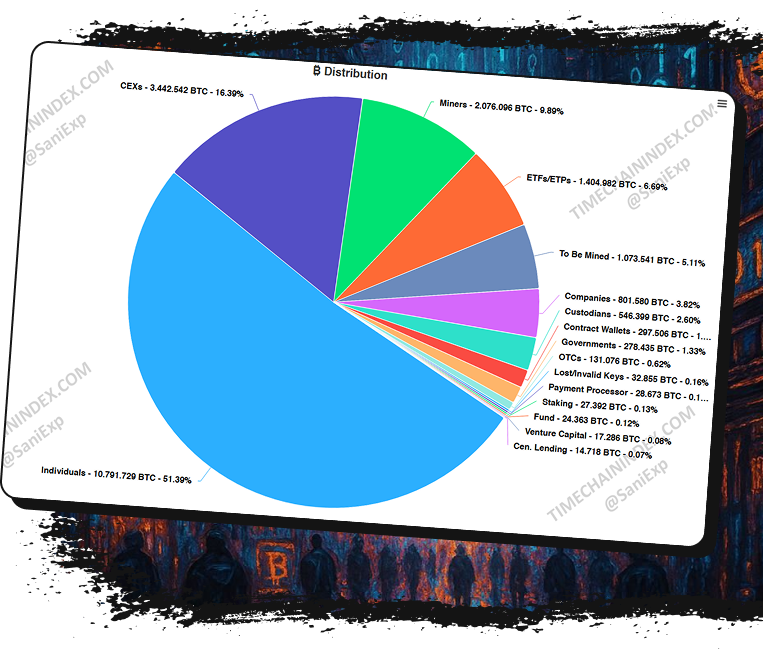
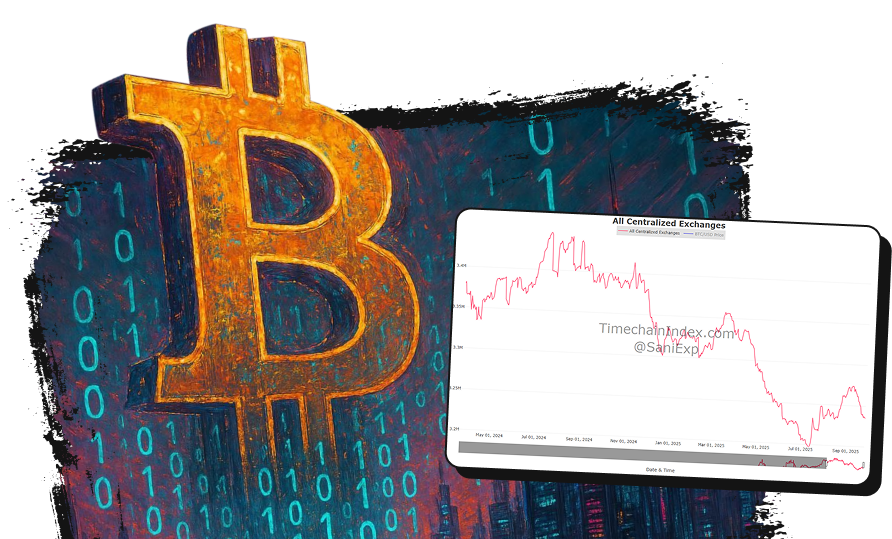
To say that is impressive is a massive understatement. Your site has pretty much become my go-to source when people say “Exchanges are running out of Bitcoin ” or “OTC desks are empty.” The first thing I do is head over to your site and check. The idea that OTC or CEXs are running out of Bitcoin is directly tied to the “supply squeeze” fantasy that I’m sure we’re all guilty of day dreaming about from time to time.
Have you made any observations about a decrease in CEXs and OTC coins since you started the project?
Sani:
Not as much as people think they did. Remember we had around 1.5m btc going into ETFsand companies. I don’t think they decreased as much 200,000-300,000 in total. A lot of people sold. People will sell at the price they think is best for them. As we saw a few days ago the guy that moved the 80k already sold 40k to Galaxy Digital and in turn they all went into exchanges. Then part to ETFs. The balances have been holding well above 3m since I started tracking them.
Anthony:
Which brings us to where we started. When I did a call out for articles on the subject of paper Bitcoin, you responded by saying something to the effect of, you don’t really see evidence of it.
Can you elaborate on that, or correct me if I’m misrepresenting what you said or meant?
Sani:
Basically everyone is assuming that companies or ETFs don’t hold what they claim on-chain.
This is wrong – they do. At least from the data I gathered I believe that they do. ETFs 100% backed 1:1 on chain. I have all the data. For companies, I have a majority of the large ones.
Anthony:
Matching up the ETFs is fairly straightforward If you have the UTXOs I suppose.
Do they post their UTXOs? If not how would you know which ones are theirs?
Sani:
Mostly they all use the same addresses, except Blackrock which has a specific pattern so it’s easy to identify them.
No, I don’t post the UTXOs or addresses. Pretty much everyone has a pattern, evenpattern even exchanges, and that’s how I am able to update the labels when the coins move.
Anthony:
Ok so you’re super clever. I can accept that. You’ve basically matched known information with patterns and the result is information that you have high confidence in?
Sani:
Basically if you look at my data on the site, there are all data and verified data tabs. Verified I’m 99.99% sure of. All data include some speculation labels and individual x entities. I’m very transparent with what I present.
Anthony:
Have you caught a company or entity lying based on your data?
Sani:
Not so far.
Anthony:
Ok that’s very interesting. Considering Wall Street has developed a culture of not showing their stacks,. I thought for sure someone would have gotten caught with their hand in the cookie jar.
Do you have any thoughts on derivatives and they impact the network?
Sani:
I think cause they are still too early in the game, they are playing it cool until they can manage to corrupt something :p
Can you elaborate on the second question?
Anthony:
It’s an open-ended question. Some people view derivatives as a source of liquidity that’s good for Bitcoin, and some people view it as nothing but paper which siphons wealth away from Bitcoin. Considering your unique perspective I was wondering what you thought.
Sani:
I mainly focus on final settlements on-chain, and tracking where all the bitcoin is going.
I’m not really technically experienced to answer this question, so I only focus on finding what companies, ETFs, exchanges… claim to have as reserves.
I don’t do market analysis since it is not my area of expertise.
Anthony:
Fair enough.
I recall you replying to someone who had stated that “OTC was running out of coins.” Again with the supply shock fantasy. Your response was essentially that OTC had access to lots of coins anytime they wantedwant.
Could you clarifyCould clarify what you meant? And where would the coins come from?
Sani:
A majority of people think that if OTCs run out of coins then the price will explode as if they are the only ones with coins to sell, as we saw this past week someone moved 80,000 BTC from 14 years ago and sold them to Galaxy Digital;, someone will always be willing to sell to the OTCs for the right price., Also, exchanges will provide liquidity to them when needed, as Ii see from Coinbase every time while they moved 8,000 BTC from their cold storage to supply to their OTC desk.
Anthony:
Ok so the accounting for OTC on youryou site isn’t really the full picture because they can draw coins from other places if need be.
Do you think supply squeezes are just bull fiction?
Sani:
Correct,
to some extent it is easy –, there are still millions available for sale. U
extent it is*
unless we experience a huge demand at the same time, and OTCs can’t stack fast enough, we might see a parabolic rise in price.
So we’re not seeing any supply squeeze in the near future.
Anthony:
Ok so that makes sense. With the introduction of Wall Street, a ton of liquidity has entered the network. Lots of buyers but also lots of sellers. So you’re not seeing any evidence of an impending supply squeeze.
Do you think cycles are still a thing? Or has the market changed from the 4 year paradigm?
Sani:
Still too early to tell.
Anthony:
Agree. Like most things in life we’ll just have to wait and see.
Just for fun,Just fun , do youdo you have any predictions about this cycle?
Sani:
No, Ii don’tdnt do predictions but hopefully higher than now.
Doggo:
Sani, you’veSani you’ve repeatedly mentioned that you’re 99% sure on the data you have.
Could you explain the verified data tabs you mentioned?
What are the patterns you mentioned and how can someone do the verifying for him/herselfthemreself?
Sani:
A Majority of exchanges or entitiesy haveha s a specific pattern.
For eExample, Kraken always spends or consolidates and returns the remaining funds to the last output,
So basically I give my script the addresses, and it automatically gets all the output transactions and recursively keeps adding the last output until it hits an unspent output, and then it moves on to the next transaction/address.
Coinbase custody has an agreement with its clients that they cover the transaction fees, so whenever they make a transaction they send the fees from one specific address the fees, so Ii just scan that address for all outflows;, this way at least you u can make sure that this address is under Ccoinbase custody.
Coinbase OTC otc also pays everything from 1 address.
Coinbase exchange has a specific pattern on how they pay clients and how they rotate the funds.
Here’s a video of how Coinbase splits their larger addresses and rotates them into smaller addresses:
This is my own explorer connected to my server, which allows me to view the address labels directly in the site if available;, also, it allows me to add labels directly to the server.
Doggo:
Very interesting. What can plebs do to learn more about on-chain analysis and also do basic verifying about certain addressesadresses or entities?
Sani:
Unless you have the main addresses labeled or indexed for that certain entity, you will be working blind with a transaction., Ii guess Arkham is the biggest public source to view these details to a certain extent..
But it’s still lagging behind on some stuff like for example when Coinbase addresses get split or move they don’t add the new addresses
Until they do a mass update which takes months sometimes.
Two years ago Ii didn’t know anything about this these stuff or Bitcoin in general –, I’d look at a transaction and get confused, like what is this?
But the main thing is to have labels to see clearly how things are moving.
Doggo:
So identifying entities, labeling them and then continuing from there on to decipher addresses? How did you learn this?
Sani:
It just came to be., I didn’t have any kind of background regarding this, but found out Ii was good at it, i lt and it was very easy to me –, came naturally.
Doggo:
Considering your knowledge regarding on-chain informations,
what are your five recommendations you’d give every pleb to keep their privacy and opsec safe?
Sani:
First of all you need to hide your activity from someone like me –, don’t hold very large UTXOs and keep moving your coins every year or two2, and don’t let them sleep for too long ‘cause it will trigger some alarms when you do.
People sleep on coins for 5-10 years and when they move everyone is making posts about them.
I Literally made a post yesterday about someone moving a 0.9 BTC mining reward from 14 years ago.
The 0.9 BTC wasn’t the trigger, but the fact that it has been dormant for 124 years did
‘Cause Ii have already indexed the unspent Coinbase rewards by year of creation.
14*
Anthony:
Which part do we not make public? The Coinbase part?
Sani:
I prefer both if possible, but Coinbase is more important.
If you want you can say that each exchange or entity has its own pattern, that makes it easy to identify addresses belonging to them.
Anthony:
Ok is it cool if I leave it the same but I just ******** over the name of the exchange?
Or do you just want me to exclude the entire answer?
Doggo:
Fack😂
1.What do you consider large UTXOs?
2.What are other criteria that draw attention besides size and age of a UTXO?
Sani:
For individuals I think as a total address shouldn’t have more than 1 BTC, with 4-5 UTXOs max.
These are the two2 major alerts –, nothing as important comes to mind.
Anthony:
Seems reasonable.
We’ve learned that according to your work there doesn’t seem to be evidence that ETFs, CEXs and Treasury companies don’t have the Bitcoin they say they have. I for one am a little surprised considering the culture of Wall Street to push derivatives to their fullest extent and create complicated structures. So I and our readers are going to have to chew on the information you’ve provided.
Is there anything about what we’ve discussed that you’d like Stackchain magazine readers to know ? Perhaps something relevant that we may have missed?
Oh you know what? I did have another question.
The US is said to have 200,000 Bitcoin. But reports by Senator Lumis I believe suggests the US may only have 28-29k.
Does your research shed any light on this?
Sani:
The report that was misleading by that reporter that published it – then she made the clarification, Ii guess after they got the payment from David
and Lumis also doesn’t understand shit; also she just says what they pay her to say.
The 28k are just part of the holdings within the US Gov;, they are the forfeited bitcoin only, not all of the confiscated bitcoin. For, example, Bitfinex has a little less that 100k BTC as Ii remember with the FBI or DOJ, these are still being contested in court and they want them back, meaning they have not been forfeited yet, so they won’t be included in the 28k report that was shown., There are several departments each holding their own bitcoin, but the one that was shown only shows the forfeited coins held by the US Marshalls.
In total they have around around around 200,000 BTC.
I mainly try to verify what you read from as many sources as possible before jumping into false conclusions:, consolidate your UTXOs, keep your coins on the move at least once every 1-2 years, revise your wallet setup at least twice a year so you don’t forget how to recover it.
Anthony:
Great advice.
Why move your coins every 1-2 years?
Sani:
So you don’t move them after 10 years and everyone is now watching your coins
‘cause ancient coins are moving again.
Imagine our coins from now moving in 10 years –, the news will be lit.
Anthony:
I see –, less attention.
I thought the answer had to do with using address schemes that are newer, alludingnewer eluiding to them being better.
Sani:
Not necessarily., A lot of legacy and nested segwit addresses move 24/7, nothing triggering there.
Just don’t let them sleep a lot.
I know a lot of people who were buying way way back in the day.
Now they are afraid of moving their coins because it will trigger a lot of alarms.
Guess they will never be able to spend these coins.
Anthony:
If they can’t figure it out they can always send them to you and I.
Sani:
😂😂
I’ll probably dox myself if they send them to me 😂
Anthony:
The things we’re willing to do for a few sats.
Do you have any last thoughts you’d like to share with our readers?
Sani:
Nothing comes to mind.
If youu want when youu polish the article, Ii can read it and maybe we can add something here and there.
Doggo:
Can hue say sumfink wif shawarma so we hab it in interview ?
Sani:
Shawarma is the only thing better than Bitcoin 😂
Note from Stackchain Magazine: No Bitcoin (or inferior monies) were exchanged for this article. You can find Sani on X @SaniExp and on Nostr sani@timechainindex.com. If you’d like to send Sani some 丰 for the article you can do so via LN sani@walletofsatoshi.com