


The Half-Philosopher Problem: Partial Political Perception & the Role of Bitcoin
In today’s polarized political landscape, individuals often align themselves strongly with either the right or the left, the red or the blue, the conservative or the liberal. This alignment, while providing a sense of identity and belonging, also comes with significant downsides: it limits one’s perception of reality. The majority of people, by analyzing the world solely through their political leanings and associated media consumption, can thus be considered “half-philosophers.”
One View of the Elephant
Political polarization has become more pronounced over the years. According to the Pew Research Center, the number of Americans holding consistently liberal or conservative views has doubled in the past two decades, while the center has shrunk significantly. This ideological uniformity means that individuals are more likely to consume information that reinforces their existing beliefs, leading to a more fragmented and biased understanding of reality.
When individuals analyze reality through the lens of their political leaning, they often engage in what can be described as “motivated reasoning.” This is the tendency to fit new information into existing belief systems rather than adjusting those beliefs based on new evidence. As a result, they only see the portion of reality that aligns with their ideological stance. This phenomenon is exacerbated by the echo chambers created by social media and partisan news sources, which further entrench individuals in their beliefs.
Philosophers have long emphasized the importance of argumentation and reasoning in understanding reality. Argumentation involves the exchange of reasons and is crucial for filtering information and reaching well-justified conclusions. The ability to see both sides of an argument, often referred to as “steel-manning,” is a key philosophical skill that allows individuals to understand the strengths and weaknesses of opposing viewpoints. Otherwise, we’re just looking at one view of the elephant. Many of us are perceiving only a portion of reality.
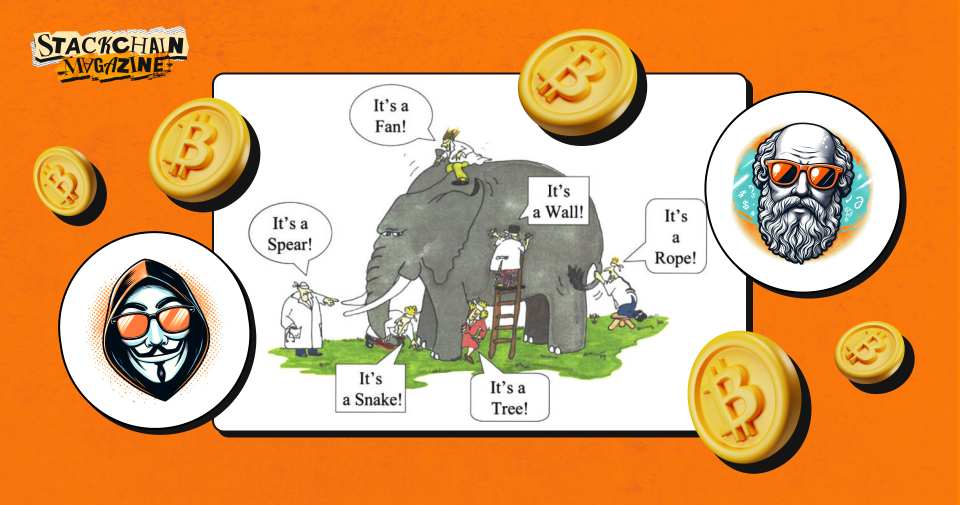
Found in the wild on X/Twitter
Bitcoin Incentivises This
Bitcoin offers a unique solution to the half-philosopher problem by providing a consistent and objective view of reality. As Michael Saylor discusses, Bitcoin operates as a “truth machine” due to its inherent properties of proof-of-work, which ensure the integrity and veracity of the information recorded in its ledger. Bitcoin’s technology ensures that transactions are transparent, immutable, and verifiable. This transparency acts as a truth machine, enabling individuals to trust the information recorded without relying on centralized authorities or intermediaries (ie – governments & polarized media outlets). We can now rely on a more foundational, accurate understanding of financial and economic realities.

Bitcoin’s decentralized nature and fixed supply make it an ideal measuring stick for value, free from the manipulation and biases that affect traditional financial systems. This objectivity allows individuals to evaluate economic realities without the distortions introduced by political ideologies. As highlighted in the article Bitcoin as a Measuring Stick, Bitcoin provides a consistent standard against which other assets and economic activities can be measured, offering a clearer picture of economic reality.
As famed investor Bill Miller IV states, “The reality is there’s a real demand globally for an uncensorable asset where The Regulators can’t change the rules and the measuring stick over time.” Since money touches everything, the perception of literally anything can be augmented through the use of easily augmentable government money (aka – fiat). If we agree to use a money that is fundamentally based on truth, could we not then expect second- and third-order effects to proliferate throughout society?
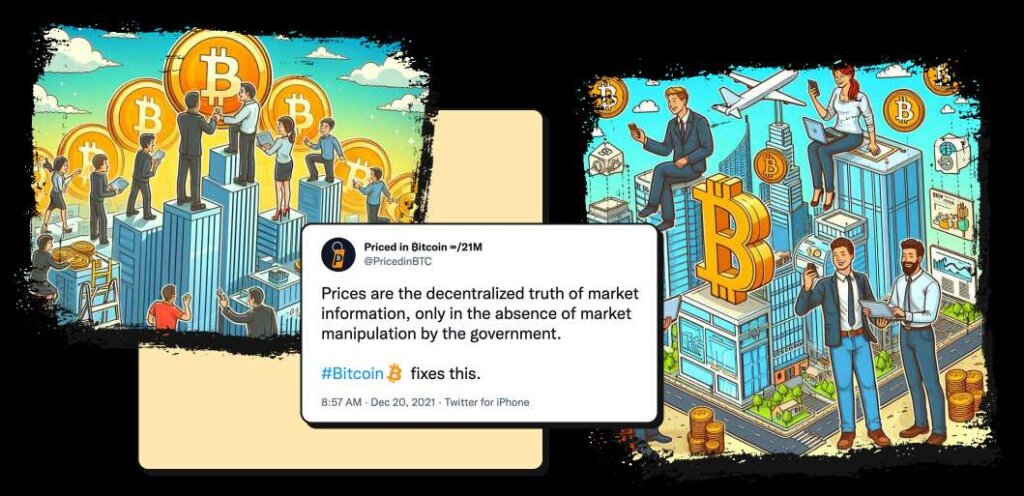
Found in the wild on X/Twitter
Orange-Colored Glasses
Bitcoin ownership spans the political spectrum, debunking the myth that it is tied to any particular political ideology. According to a recent study by Andrew Perkins & Troy Cross, “Bitcoin ownership is not meaningfully related to political orientation. Like Americans in general, American Bitcoiners can be found across the political spectrum but they tend to be moderates.” This finding underscores the apolitical nature of Bitcoin, as it attracts individuals from diverse political backgrounds who share a common interest in its potential.
To move beyond being half-philosophers, individuals can study Bitcoin to gain a more holistic understanding of reality. This involves engaging with objective standards. By using Bitcoin as a consistent measuring stick, individuals can evaluate economic realities without the distortions of political ideologies. We also need to place a higher value on transparent systems. Bitcoin’s properties provide a transparent, verifiable, and immutable record of transactions, fostering trust in the information and reducing the influence of biases. How about we bring back critical thinking? Doing so can help individuals evaluate information more objectively and reduce the influence of biases as opposed to the over reliance on emotional reactions. Open-mindedness is key; being open to changing one’s views based on new evidence is crucial for developing a more accurate understanding of reality. All of this can be achieved by viewing “reality” less from red- or blue-colored glasses and more from orange-colored glasses.
In a world increasingly divided by political ideologies, it is essential to recognize the limitations of viewing reality through a single political lens. By adopting a more grounded approach based on truth and consistent measurement, individuals can move beyond being half-philosophers and develop a fuller, more accurate understanding of the world. This shift requires a commitment to engaging with objective standards, trusting transparent systems, and cultivating critical thinking and open-mindedness. Only then can we hope to bridge the divides and see the bigger picture. By adopting orange-colored glasses, we all can potentially evolve past the phenomenon of half-philosophers.

Found in the wild on X/Twitter
Note from Stackchain Magazine: No Bitcoin (or inferior monies) were exchanged for this article. This article was written by Tim Niemeyer Free Lance Content Creator and Author. If you’re not following this pleb you probably should. You can find him on X @Tim_niemeyer_ .If you enjoyed this article you can tip Tim via is LNURL timniemeyer@strike.me