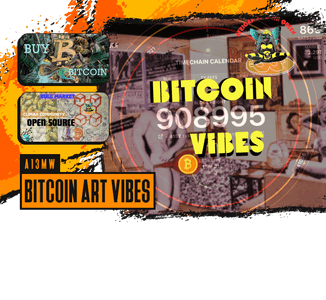
BITCOIN ART VIBES
by A13MW
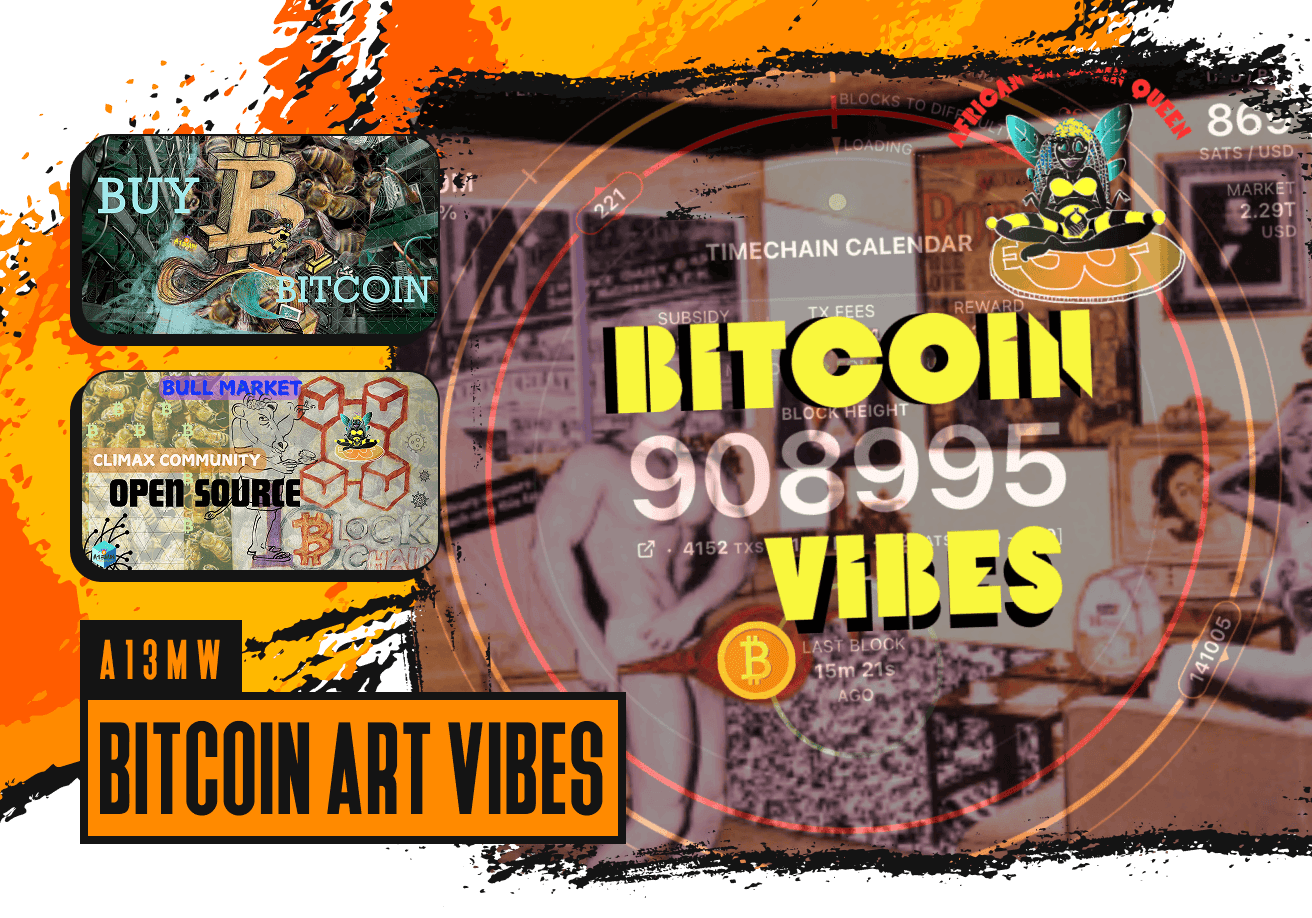
This image is an updated version of Hamilton’s piece entitled: Just what is it that makes today’s homes so different, so appealing? Ground Zero of Pop Art, the original work was dubbed “popular, transient, expendable, low-cost, mass-produced, young, witty, sexy, gimmicky, glamorous, and Big Business”.
Bitcoin as a Symbol
Understanding Bitcoin changes the way one perceives everything. When I first joined the Bitcoin Art Magazine group, somebody told me that I should make art that did not include the BTC symbol. Ludicrous, the BTC symbol references the concept of Bitcoin. Finding a symbol on which one can construct a mental model encourages rapid adoption. A recent article in Bitcoin Magazine writes about Bitcoin art in corporate art collections. It shows a photo of not one, but two Big ₿ Bitcoin symbols on the walls of a corporation.
Bitcoin is a revolutionary form of money invisible in the real world, finite in its quantity, and kept safe from authoritarian governments by cryptographic keys. Its Proof of Work protocol demonstrates that energy is required to solve the cryptographic puzzle associated with each block. Proof of stake, in contrast, allows the CEO of an altcoin to declare that there is a certain number of coins for sale. It is money by decree.
Money, in the form of gold or coins or as paper, has been around for thousands of years. Since Bitcoin is innovative, art about Bitcoin is not conventional. Its forms range from paintings to drawings, to sculptures and multi-media pieces, to graffiti and jewelry, to merchandise, and finally, to NFT-like Ordinals. What they have in common is the sacred, the digital, and the meme-infused.
McLuhan wrote, “The role of the artist is to update consciousness.” Going down the Bitcoin rabbit hole to figure out what money is, shifts consciousness. Seeing the violence of fiat in human affairs changes the way one thinks about money, including sovereignty, agency, and privacy.
The Meme of Pepe
The myths surrounding Bitcoin spark the imagination of artists. Memes have played an enormous role in society. Social media and cryptocurrencies, especially Bitcoin, love them! One meme captured the imagination of early Bitcoiners: Pepe the Frog. Its origins as a Boy’s Club character who took a piss and then expressed his feelings resulted in a self-replicating unit of culture. It was appropriated from the original artist and made into an ugly symbol of the alt-right.
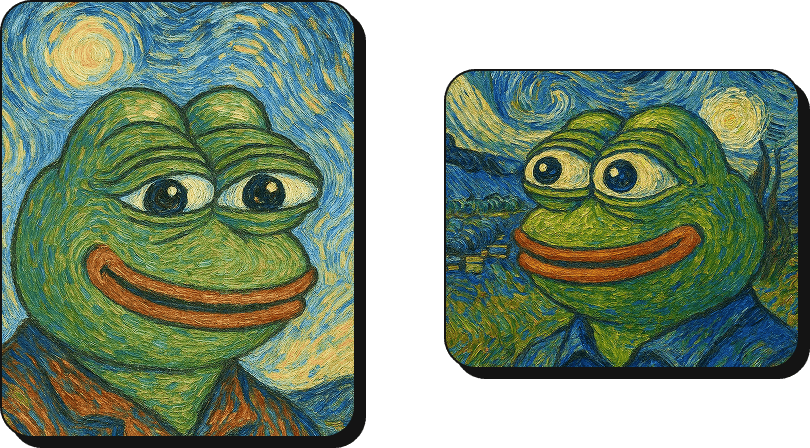
Memes are viruses of the mind. The original creation story of the frog dates back to ancient Egypt. In Africa, the frog symbolized fertility and life. European references, however, cite Europe as having the first frog myth creation story. There, in what I call Frog-landia, frogs were portrayed as wicked and associated with witches.
Bitcoin and Pop Art
Many Bitcoin artists reference Pop artists like Banksy and Warhol. Pop Art drew inspiration from popular and commercial culture, including advertising. The irony found in Pop Art lingers on in Bitcoin Art. Bitcoin artists love elevated art, in stark contrast to the philosophy of Pop Art, which thumbed its nose at it and embraced mass-produced works.
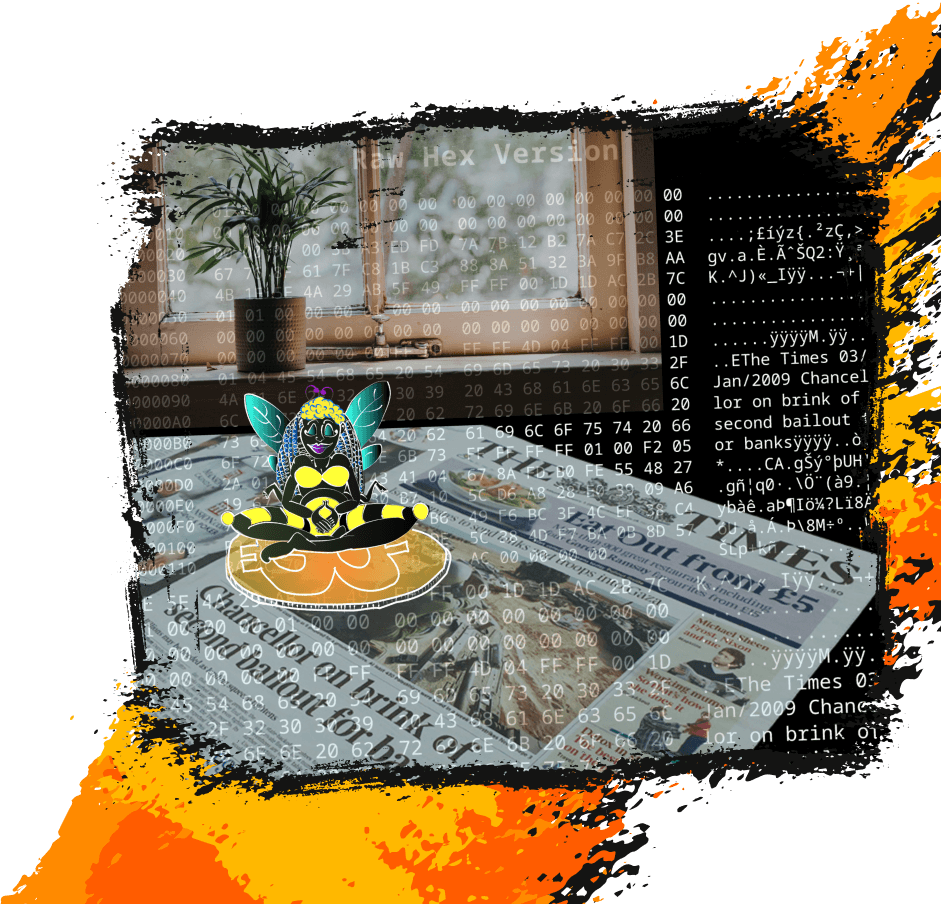
Taking art off its “high horse” and placing it in the street is something that Banksy excels at. Banksy has also made NFTs. A recent performance included burning a print and then digitizing it and selling it as an NFT. While Bitcoin artists admire the conceptual work of Banksy, most do not like NFTs. Even more objectionable is a digital piece saved to the BTC Blockchain because ART is not MONEY. Although art can increase in value based on its cultural capital, it emerges through meme-plexes that include religions, political ideologies, artistic styles, social movements, and language. Traditional art was transactional, trading on the knowledge of established memes backed by the Church or the State. Bitcoin seeks memes that separate Money from the State.
Bitcoin Art for Bitcoin OGs
Most Bitcoin Artists are American or European, and their work is Eurocentric. For the past decade, they have been creating Bitcoin art, attending conferences in America and Europe where they exhibit, network, and sell their work. Art collectors are rare and elite. Many argue that making art is an elite activity. A recent show about art, money, and society, shown at an Oxford Gallery and entitled ‘Exploring Money through Art”, does not point to a single Bitcoin artist. It mentions crypto currencies, NFTs and AI, and shows a piece by Alexander Cornelius, a German Painter. His work, the review states, “examines the global financial system.” His piece is entitled “In Cryptography We Trust”. While cryptography is core to Bitcoin, all cryptocurrencies use it. Bitcoin artists have not yet begun the task of updating the consciousness of the art world when it comes to Bitcoin.
“The fascination with money is that — besides sex and death…
a phenomenon about which we do not speak, it is one
of the determining factors of human existence.” — Uta Tackenberg.
This quote explains, perhaps, why my animated short entitled “Love, Sex, Drugs, and Money in Jamaica” was not given any mention at the Warsaw Bitcoin Film Festival. Furthermore, when I exhibited my poster at the Bitcoin Rodeo, I was asked in hushed tones where my X-rated work was. Meanwhile, a construction worker, turned producer, was invited on stage to promote his animated series. He showcased an extremely violent clip. It received no criticism. In our current society, the violence of FIAT is acceptable, whereas memes concerning sex and money are not.
Do Bitcoin artists create for the masses or for elite OG’s? In August, I traveled to Boston for the first African Bitcoin Conference in the Diaspora. Africans are adopting Bitcoin rapidly to cut the predatory costs of remittances sent to family in Africa. BTC is also used to endure the inflationary effects of currencies propped up by colonial governments and authoritarian regimes. In Africa, Bitcoin is not about speculation; it is about survival.
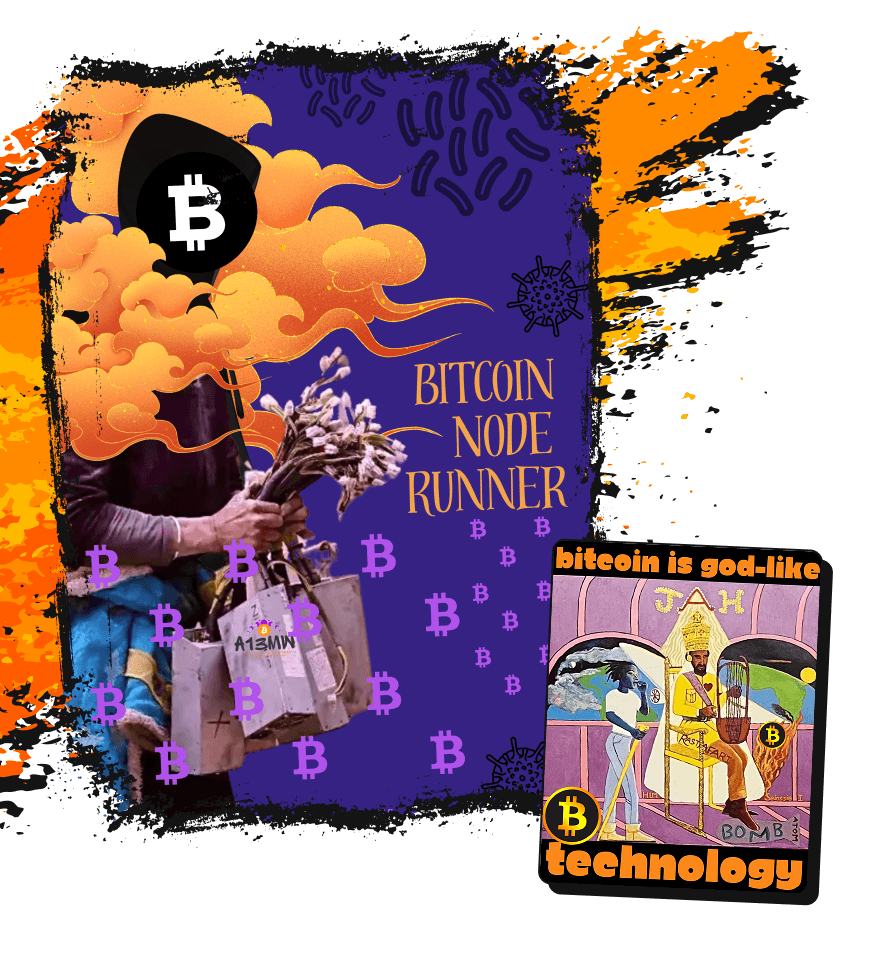
Bitcoin Art is non-existent in Africa, except for Bitcoin merchandise that includes the BTC symbol surrounded by traditional African designs. The research of Ella Hough, a recent Cornell graduate now on Team Saylor, reveals that awareness of the core concepts of Bitcoin is low in Africa compared to the practical use of wallets that provide cheap, fast, and secure Bitcoin transactions.
BTC is a global asset, not an American one. Global adoption, in which China played a crucial role through the early mining of BTC, is explored in a book by Roger Huang called “Would Mao Hold Bitcoin?” Some argue that Africa is the future of Bitcoin due to its rapid adoption rates, which far outpace those of Americans. Author Charlene Fadirepo of “The Bitcoin Leap” reveals a narrative centered on Bitcoin’s transformative potential in Africa. In closing, the question I ask my fellow Bitcoin artists is: “Are you here for the money or for the revolution?” If “culture is our business” and your answer is revolution, don’t give up your day job any time soon.
Note from Stackchain Magazine: No Bitcoin (or inferior monies) were exchanged for this article. This article was written by A13MW, a Bitcoin artist. A former UX Designer & Social Information Architect, her style is MetaModern and fungal-infused. She is passionate about the mutual aid between mushrooms & bees. you can find her on X @enrichedbycode on Nostr A13MW@primal.net. If you’d like to send A13MW some 丰 for the article you can do so via LNURL A13MW@primal.net
For more info, visit her website www.a13mw.com.