

The Intersection of Bitcoin and Urbanism
By JelloShooter
History’s a long story of wild, unregulated chaos slowly getting swallowed by control freaks, human creativity drowned in red tape, stamped with a government seal. In the past, people traded shells, coins, and goods without a second thought, free from the grasp of governments. Cities sprang up wherever people gathered, evolving naturally, adapting to the needs and desires of those who lived in them. There were no blueprints, no central authorities dictating where roads should go or how tall a building could be. These were organic creations, as alive as the people who built them.
But over time, control tightened. Money became the exclusive domain of the state, and cities fell under the rigid rule of planners and bureaucrats. What was once a free exchange of value and ideas became a system of compliance and conformity. We traded freedom for the illusion of stability, and in doing so, we lost something vital.
We’ve been here before. Money without the iron grip of the state—it’s not some pie-in-the-sky fantasy. History shows us that once upon a time, currency could breathe free, unshackled from government control. As with most things, however, convenience won out. Centralized money, with all its bureaucratic baggage, became the status quo, and the rest is a grimly predictable tale. The Song Dynasty in China figured this out back in the 11th century, claiming a stranglehold on money issuance. Fast forward to today, and everyone’s playing the same tired game, forced to bow to the almighty government-issued buck.
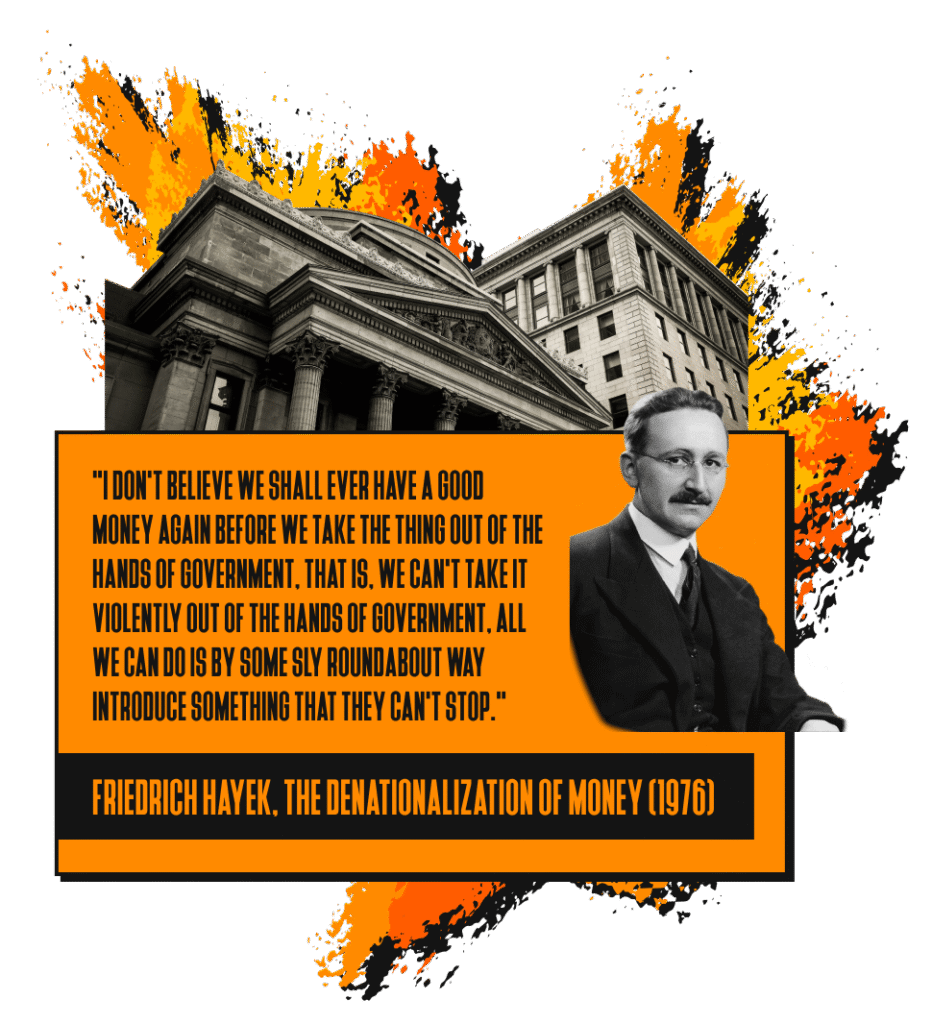
“I don’t believe we shall ever have a good money again before we take the thing out of the hands of government, that is, we can’t take it violently out of the hands of government, all we can do is by some sly roundabout way introduce something that they can’t stop.”
— Friedrich Hayek, The Denationalization of Money (1976)
Enter Bitcoin—arguably the most disruptive technology of our time, a digital gut punch to the state monopoly on money. Bitcoin isn’t just some nerdy dream; it’s the first real shot at breaking the chains of fiat dependence. It’s decentralized, running on tens of thousands of machines worldwide, making it damn near impossible for any government to wrap their greasy paws around it.
Government-controlled money? Sure, but it’s a trust game, and as Satoshi Nakamoto bluntly put it:
“The central bank must be trusted not to debase the currency, but the history of fiat currencies is full of breaches of that trust. Banks must be trusted to hold our money and transfer it electronically, but they lend it out in waves of credit bubbles with barely a fraction in reserve. We have to trust them with our privacy, trust them not to let identity thieves drain our accounts.”
Bitcoin flips the script. Governments can keep printing their funny money, but for the first time, we’ve got a way to say, “No thanks, I’ll pass.”
But what’s this got to do with urbanism? Everything. Just as money has been monopolized so too have our cities, stifling their life and vitality.
Urbanism:
noun
The way of life characteristic of cities and towns.
Urbanism, before it became a playground for bureaucrats, was beautifully chaotic and decentralized. Cities were organic beasts, growing and morphing without some pencil-pushing planner telling you what color you could paint your front door. There were no neat little boxes, no restrictive zoning laws, no thumb-twiddling committees. You want to slap together a house, a shop, or whatever? Go for it. Cities thrived on this unregulated freedom, constantly reshaping themselves to suit the people living in them. But now, every brick and street corner is drowning in red tape.
Take San Francisco, for example—a woman there got hit with a $1,400 fine for daring to set up a “free library” in front of her house. That’s the level of micromanagement we’re dealing with. The planners and regulators have drained the lifeblood out of urban development, leaving us with sterile, predictable cities that lack the vibrant pulse of their predecessors. They’ve turned urbanism into a monotonous drone, where every building must fit into a government-mandated mold.
Sure, some rules make sense—like those that keep buildings from collapsing on our heads—but most of these regulations? They’re arbitrary power trips. Parking minimums, setback requirements, density caps—they’re just bureaucratic shackles on what should be our basic property rights. And don’t even get me started on free parking mandates. It’s like forcing someone to give away land for free car storage. This isn’t just inconvenient; it’s a quiet form of socialism that crushes the spirit of individual autonomy.
These rules are the death knell of urban innovation. They snuff out the possibility for cities to evolve naturally, to adapt to the needs of the people living in them. Instead, we’re stuck trusting central planners to know what’s best for everyone—where things should go, how tall buildings should be, how many people can live on a block. Sound familiar? It’s the same top-down control we see in government-controlled money, and it’s just as stifling.
So, like money, our cities have been hijacked by government monopoly. The question is: What can we do about it?
Bitcoin’s here to stir the pot. This decentralized digital currency doesn’t just challenge the old financial system—it’s a manifesto for a new way of thinking about value, ownership, and exchange. Just like the unregulated cities of old, Bitcoin thrives on decentralization. There’s no central authority, no puppet master pulling the strings, but a direct, peer-to-peer currency that doesn’t need permission to exist. That is where it gets interesting for urbanism.
Imagine cities powered by the principles of decentralization that Bitcoin embodies. Cities that are shaped by the people living in them, not by some distant bureaucrat with a checklist. Imagine being able to use your property as you see fit—without a stack of permits and the looming threat of fines. Imagine turning an empty garage into a small shop. Adding apartments to your property to provide income into old age—all without the need to partition hundreds of square feet of your land to car storage. What if the amount of car storage (i.e. parking) could be dictated by market supply and demand instead of the cookie cutter, soul crushing, and utterly mundane tedium of parking minimums?
Could Bitcoin help us reclaim the wild, unregulated energy that used to drive urban growth? Could it pave the way for cities that are more responsive to their inhabitants, less bogged down by arbitrary rules, and more aligned with the principles of freedom and innovation?
Probably not, but it’s fun to imagine a future with more freedom and flexibility that’s driven by the people, not the state.
So I’ll make my own “Hayekian” proclamation here:
I don’t believe we will have great cities again until we strip the bureaucrats of their power and return city building to the hands of the people. With the creation of Bitcoin, we may have the means to undermine centralized authority—not through force, but through innovation.
________
Note from Stackchain Magazine: No Bitcoin (or inferior monies) were exchanged for this article. Jelloshooter is a regular contributor to Stackchain Magazine and we are grateful for his many submissions. You can find him on X @jelloshooter848 or on Nostr jelloshooter848@vlt.ge. If you’d like to send Jelloshooter some 丰 for the article you can do so via LNURL jelloshooter848@vlt.ge