
Property Rights: What Nature Teaches Us About True Ownership
by Oz
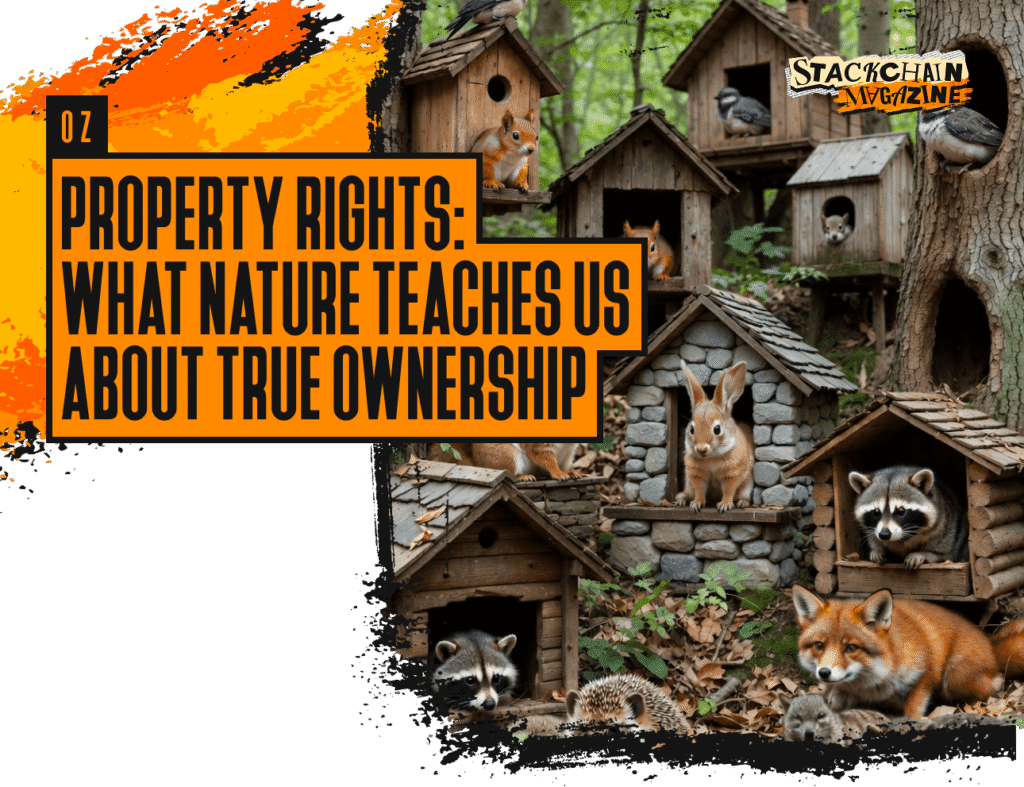
When you watch a bird build its nest, something becomes immediately clear: the bird doesn’t pay rent. It doesn’t file paperwork. It doesn’t receive a tax bill each year threatening to evict it if payment isn’t made. The bird simply builds, occupies, and defends its home. That’s ownership in its purest form.
Walk through any forest and you’ll see property rights everywhere. Wolves mark and defend territories. Squirrels cache nuts for winter and return to claim them. Bears claim caves. These aren’t social constructs or legal fictions—they’re natural expressions of a fundamental principle: the right to claim, use, and benefit from resources.
In nature, the cost of property is simple: the energy required to acquire and defend it. A bird must be strong enough to build its nest and vigilant enough to keep predators away. A wolf pack must be powerful enough to hold its territory against rivals. There are no ongoing tribute payments to some higher authority. Possession, defended through strength or cleverness, is ownership.
Now consider your own home.
You work for years, perhaps decades, to pay off a mortgage. You pour your labor, your time, your life energy into making that final payment. The bank no longer has a claim. The property is “yours.” You have a deed with your name on it.
But stop paying your property tax and see what happens.
First come the notices. Then the penalties. Then the liens. Eventually, armed agents of the state will arrive and remove you from “your” property. It will be sold to satisfy the debt you owe to the government—a debt that renews itself every single year, forever, until you die.
You don’t own your home. You rent it from the state.
This isn’t how property works in nature. No squirrel pays annual tribute on its nest. No wolf sends a percentage of its hunt to a higher authority to maintain its territory. The very concept would be absurd—yet we’ve accepted it as normal, inevitable, just “the way things are.”
But it wasn’t always this way, and it doesn’t have to be.
Property tax, in its modern form, is a relatively recent invention in human history. For most of civilization, if you built or bought a home, it was yours. Taxes existed, certainly, but they were typically levied on transactions, harvests, or trade—not on the ongoing ownership of your family’s shelter.
The shift happened gradually. Governments needed more revenue, and property—being immobile and easily identified—made an ideal target. The justification was always the same: funding schools, roads, public services. The reality is simpler: the state claiming ultimate ownership over all land within its borders, with you as a permanent tenant.
This arrangement inverts the natural order. In nature, you defend your property from threats. Under the modern state, the greatest threat to your property is the state itself.
Think about what this means for a moment. You can work your entire life, raise your family, build your wealth, pay off every debt—and still, you never achieve true ownership of the shelter that protects your children. You are always one economic downturn, one job loss, one series of missed payments away from homelessness, not because you couldn’t afford the property itself, but because you couldn’t afford the government’s annual claim on it.
The implications run deeper than most people realize. If you don’t truly own your home, what do you own? Your car? Only until you miss the registration fees and insurance mandates. Your business? Only if you maintain the licenses, permits, and regulatory compliance. Your bank account? Only until capital controls, bail-ins, or currency debasement strip away its value.
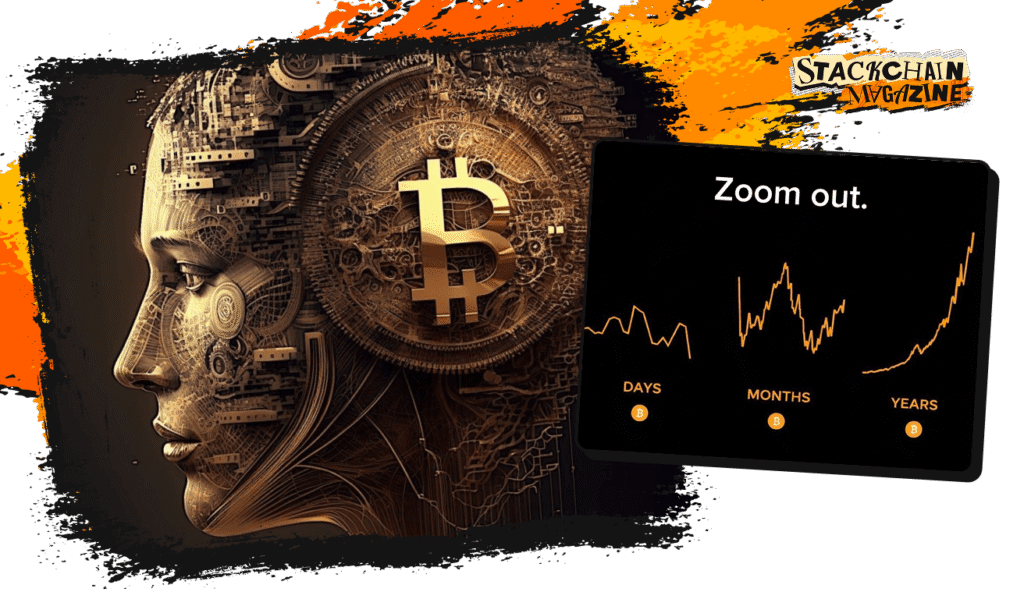
And this is where we arrive at something remarkable: Bitcoin.
Bitcoin represents the first form of property in the digital age that returns to the natural model. When you hold Bitcoin in self-custody, with keys under your control, you own it in the same way a bird owns its nest. There is no authority that can impose annual fees on your ownership.
No government can seize it without your private keys—which, if properly secured, they cannot extract from you. No bank can freeze it. No inflation can silently confiscate its purchasing power through unlimited printing.
The cost of owning Bitcoin is exactly what nature demands: the energy required to acquire it (through work, trade, or mining) and the vigilance required to defend it (through proper security practices). That’s it. No ongoing tribute. No renewal fees. No permission required.
This isn’t just a feature of Bitcoin—it’s perhaps its most revolutionary characteristic. Satoshi Nakamoto didn’t just create a new currency; he created a new form of property right, one that exists outside the reach of any state’s claimed monopoly on ownership within its borders.
But here’s what makes this moment in history particularly urgent: the same forces that turned property ownership into permanent tenancy aren’t stopping. They’re accelerating, and they’re going global.
Look around the world right now. CBDCs—central bank digital currencies—are being developed by dozens of nations simultaneously, promising the government complete visibility and control over every transaction. Digital ID schemes are rolling out from London to Delhi, creating permanent records of your movements and activities. CCTV networks blanket cities, with facial recognition turning public space into a grid of surveillance. Capital controls are normalizing, with governments increasingly limiting how much money you can move, where you can send it, and what you can do with it.
These aren’t isolated developments in authoritarian regimes. They’re happening everywhere, all at once, in democracies and dictatorships alike. The infrastructure of financial and social control is being built into the fabric of the global system.
This is different from anything in history. When the Soviet Union collapsed, it was a regional event. When Yugoslavia descended into violence, the chaos was contained. When Romania’s regime fell in bloodshed, the world continued elsewhere. These were isolated systems failing in isolation.
But today? The systems are interconnected. The world’s financial infrastructure runs on the same debt-based model, enforced by the same international institutions, dependent on the same central bank policies. A banking crisis doesn’t stop at borders anymore. A currency collapse in one major economy ripples everywhere within hours. Social unrest in one nation sparks similar movements globally through instant communication.
When systems are this tightly coupled, cascading failures don’t stay local. The global debt bubble, the coordinated monetary expansion, the simultaneous deployment of control infrastructure—these create systemic fragility on a scale humanity has never experienced.
I’m not predicting the future, and I’m not hoping for collapse. Chaos and violence mean real human suffering—families destroyed, children hungry, vulnerable people with no safety net. But I am observing the trajectory. The current system of perpetual debt, infinite monetary expansion, and ever-increasing control is not sustainable. Something will give.
Some believe the transition could be gradual—that people will increasingly opt out of the legacy system, holding wealth in Bitcoin, conducting peer-to-peer transactions, building parallel economic structures. In this view, the state’s ability to extract value simply erodes through irrelevance, the way the Soviet Union eventually collapsed without dragging the entire world into chaos.
But there’s a critical difference between then and now. When the Soviet Union fell, it was one system among many, largely isolated from the global economy. When Yugoslavia descended into civil war, or when Romania’s revolution turned bloody, these were regional tragedies, not worldwide contagions.
Today’s systems aren’t isolated. They’re interconnected in ways that have never existed before. Every major economy runs on the same debt-based model. The same central banking policies coordinate globally.
The same control infrastructure—CBDCs, digital IDs, surveillance networks, capital controls—is being deployed simultaneously across continents.
When systems are this tightly coupled, failure doesn’t stay contained. A banking crisis spreads globally within hours. A currency collapse in one major economy creates cascading ripples everywhere. This isn’t pessimism—it’s recognizing that the integrated nature of modern financial and social systems creates risks on a scale we’ve never had to navigate.
The path forward isn’t clear. It may be gradual erosion and peaceful transition. Or it may be something more disruptive. What is clear is that the current arrangement—where no one truly owns anything, where all property exists at the state’s pleasure, where control tightens year by year—cannot continue indefinitely.
Either way, Bitcoin offers something crucial: a form of property that works like nature intended. You acquire it through work. You defend it through knowledge and vigilance. You own it completely, with no higher authority capable of claiming perpetual tribute.
Nature solved the property rights problem billions of years ago. Birds don’t need deeds. Wolves don’t need bureaucrats. They build, they claim, they defend. That’s ownership.
Bitcoin brings us back to that fundamental truth, but in a form that works in the digital age. It’s not just sound money—it’s sound property. And in a world where every other form of ownership has been compromised, corrupted into permanent tenancy, that might be the most important thing of all.
Your government can tax your house. They can freeze your bank account. They can devalue your currency. They can track your spending. They can restrict your movement.
But they cannot tax what they cannot seize. And they cannot seize what they cannot find. And they cannot find what you properly secure.
In the end, perhaps the question isn’t whether property rights as we know them will survive the coming changes. The question is whether we’ll rediscover what property rights always should have been: natural, absolute, and yours to defend.
The birds have had it figured out all along.
Note from Stackchain Magazine: No Bitcoin (or inferior monies) were exchanged for this article. This article was written by Oz, Bitcoin Hodler | Node runner | Road Trip maxi| Meat eater| Ex-competing athlete| Currently building things in silence. You can find Oz on X @imabearhunter and on Nostr @Oz.