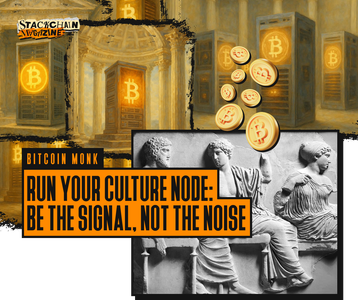
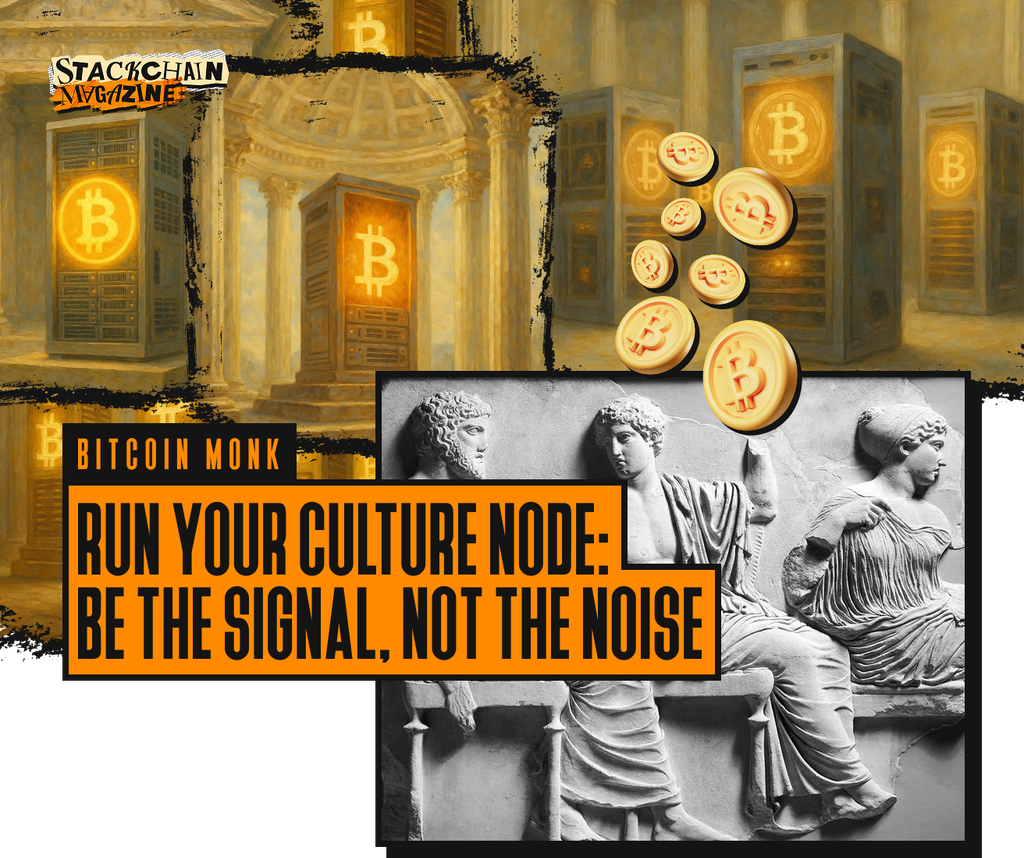
Run Your Culture Node: Be the Signal, Not the Noise
by BitcoinMonk
In the endless sea of noise, there’s a signal you’re trying to tune into. Everything else? Static.
When you tune a radio, you find the station you like and someone else chooses what plays.
But Bitcoin’s not a radio. It’s permissionless and decentralized. There’s no station manager telling you, “This is Bitcoin.” No button marked “official.”
So the real question isn’t “What is Bitcoin?” It’s: “What is Bitcoin for you?”
Finding that answer takes proof of work. You run your own node. You choose your own software. You store and relay your own copy of the chain. That’s the technical layer.
But there’s another layer too: the social layer. Just as important as running your full archival node — if not more so — is firing up your culture node. That’s how other Bitcoiners know what you run and what you stand for. That’s how we build a social consensus for what Bitcoin is.
What Is a Culture Node?
A culture node is two things at once: technical and social.
Technically, your node is just a machine — storing Bitcoin’s full history, verifying transactions, and enforcing consensus rules. You pick the software. Bitcoin Knots? Bitcoin Core? That’s your choice. Knots, for example, is Bitcoin Core plus extra filters and options — good if you believe Bitcoin should remain a monetary network. Other implementations exist too. Pick what aligns with your values.
Socially, YOU are a node! It’s your proof of work outside the code. It’s your tweets, your podcasts, your meetups. It’s the conversations you have in meatspace. It’s the ideas you choose to amplify and the ones you choose to ignore. That’s your part in Bitcoin’s social consensus rules — the unwritten norms that shape how Bitcoin evolves: Do we resist centralized control? Do we fight bloat and spam? Do we prioritize nodes or miners?
Every node runner sets those norms — or they don’t exist. Bitcoin’s culture isn’t “owned” by devs, influencers, or podcasters. It’s owned by whoever bothers to broadcast the bitcoin signal.
Why Culture Nodes Matter: The Spam Wars
If you want to see why culture matters, look at the Spam Wars. Ordinals, inscriptions, dust — all that trash raises fees, crowds out real transactions, and slows adoption for those who need Bitcoin most. Some say, “Let the devs sort it out.” No — that’s not how Bitcoin works. You sort it out by what code you run and what ideas you amplify.
In the block size wars, users chose small blocks and the decentralization of nodes. That was when node runners came up with the idea of a user activated soft fork, or UASF. Today’s fight is the same: Do you want a lean mean timechain that lasts 1,000 years? Or a data dump? Knots runners are today’s small blockers; they want less data. Core and spam apologists are the new big blockers; they want more data.
Core doesn’t decide what bitcoin is. Neither does Knots. The node runners do.
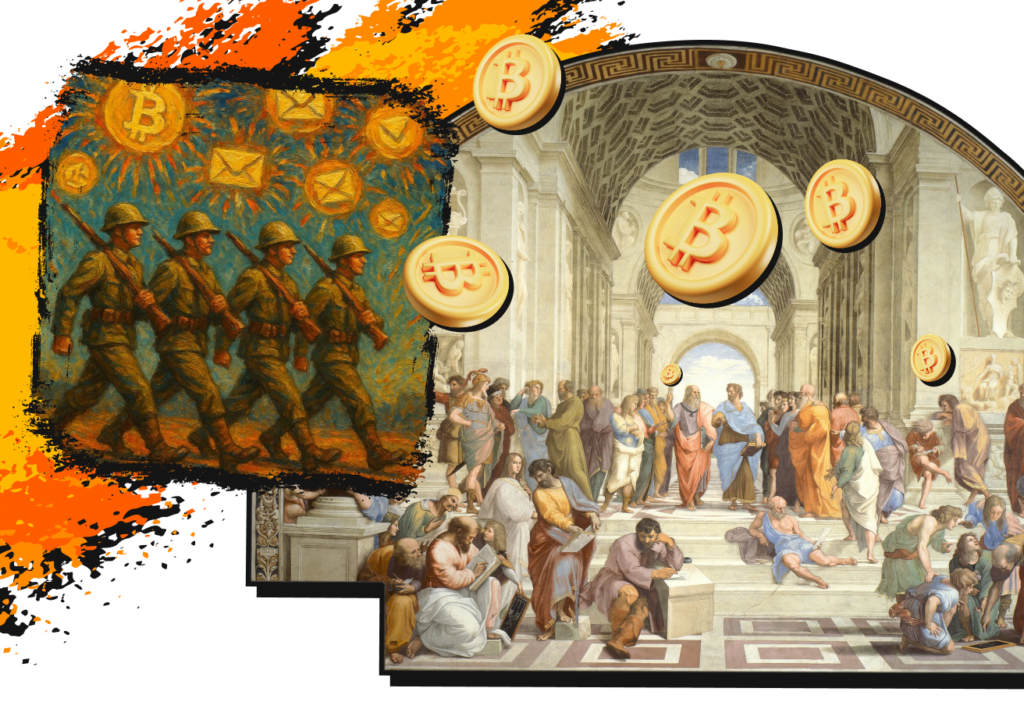
How to Run Your Culture Node
It’s simple – Be the signal.
1) Build something. Code a tool. Fix something broken. Be creative.
2) Invite others to come along. Talk to your barber. Your cousin. The stranger at the bar. Ask local businesses if they will accept bitcoin. Help them run a node. Help them become a node.
3) Go to Bitcoin events and conferences. Join a meetup or start one in your area. Every Bitcoin event is an opportunity to share the signal with others face to face.
4) Good nodes don’t just transmit — they receive. Amplify signals worth hearing. Filter out the noise.
5) Most importantly, broadcast your signal. Choose your software and run it. Start mining bitcoin and hashing your own block templates. Own your mempool and set your own policies. No one, not even Core, can force you to relay something that you don’t want to. Share your vision. Start a podcast. Start with a meme or write something. I’m making the Bitcoin Signal.
The Bitcoin Signal is my culture node. At the time of writing, it’s just an idea for a magazine. I’m still discovering what that looks like but since you can’t steer a parked car I’ll just keep moving forward. I can promise, regardless of what it looks like, it will be my honest opinion, and hopefully many others’ perspectives, on the current state of bitcoin’s culture, development, future, and current impact on the world. For me it’s one way I’ve found that I can contribute to bitcoin. God willing, it will become a place that normal bitcoiners can count on to find out what is really going on in bitcoin — where you can find pure Bitcoin Signal by the plebs and for the plebs.
Today, bitcoin has come to another crossroads. This time it’s not a chain fork — it’s a social fork. There is a new concept being promoted by some prominent bitcoiners that bitcoin is nothing special. They say ‘Bitcoin is just code that can be changed’, or ‘It’s just a database.’ I would argue that couldn’t be further from the truth.
From my perspective bitcoin is a social contract, an agreement that we all follow the same rules and that the fundamental rules can’t be changed. This is the choice each one of us has to make. It’s the culture that guides development. It’s the social consensus that makes bitcoin valuable. Bitcoin culture is what guarantees there will only ever be 21 million bitcoin, not the code.
And don’t be afraid of the technical side. If you’re already running a node — run Knots. If you’re knot — fire one up. Then show the world what you think bitcoin culture is because the plebs decide what bitcoin culture is.
Bitcoin’s culture isn’t decided by decree from some central bank. It’s created by all of us. The more of us who run culture nodes, the clearer the signal. One day, that signal might outlive every empire we know today.
Drown out the noise. Broadcast your vision.
Run your culture node today.
Note from Stackchain Magazine: No Bitcoin (or inferior monies) were exchanged for this article. This article was written by Bitcoin Monk, creator of bitcoinsignal.net. You can find Bitcoin Monk on X @BitcoinMonk21 and on Nostr @Bitcoin Monk. If you’d like to send Bitcoin Monk some 丰 for the article you can do so via LN pearmoth14@primal.net