




Fact Check: Bitcoin vs. Treasury Stocks.Who performs better?
by Ratpoison & Vee
A new breed of company has emerged over the past couple of years, pitched as the smart way for everyday investors to ride Bitcoin’s wave without directly holding the underlying asset. These “Bitcoin treasury” firms—public companies that raise capital to buy and hold Bitcoin on their balance sheets—have drawn inspiration from Michael Saylor’s playbook at Strategy (formerly MicroStrategy). They promise that their stocks will outperform Bitcoin itself, thanks to leverage, corporate savvy, and the allure of equity markets. But I’ve seen enough hype cycles to know that the Bitcoiner adage “don’t trust; verify” is needed more now than ever.
With Bitcoin’s price hovering around $115,878 as of September 20, 2025—up about 24% year-to-date from its January open of $93,425—it’s a good moment to scrutinize these proxies. Bitcoin hit an all-time high of $124,457 on August 14, only to pull back roughly 7% since then, a modest drawdown compared to its historical volatility. Meanwhile, these treasury companies have proliferated, with names like Twenty One Capital and Bitcoin Standard Treasury Company joining the fray in 2025 alone. But do they deliver for the retail investor, or is direct Bitcoin exposure still the safer, simpler bet? Let’s dig into the data, focusing on performance, risk, timing, and the pitfalls of portfolio selection. Spoiler: The evidence tilts heavily toward Bitcoin.
The Core Claim: Outperformance or Overpromise?
These companies argue that by issuing shares or debt to fund Bitcoin purchases, they create “amplified” upside. Investors get exposure to Bitcoin’s gains, plus potential premiums from market enthusiasm. But real-world data tells a different story. We examined pure treasury plays—excluding miners like MARA Holdings or ecosystem operators. (We set aside pioneers like Strategy, which started in 2020 and is up over 400% since, as it’s not a fair comp for these newcomers. Metaplanet, the Japanese firm that kicked off in 2024, is included in the comparison
with the date of US OTC availability.
Here’s a simplified table comparing key metrics. Returns are from the start of each company’s Bitcoin treasury push to October 21, 2025. Bitcoin’s return is calculated over the same period. Max drawdown measures the peak-to-trough decline in percentage terms during 2025. Because the shares have skyrocketed in a very short time and it is almost impossible to find the perfect moment to buy, the maximum drawdown is more meaningful in comparison.
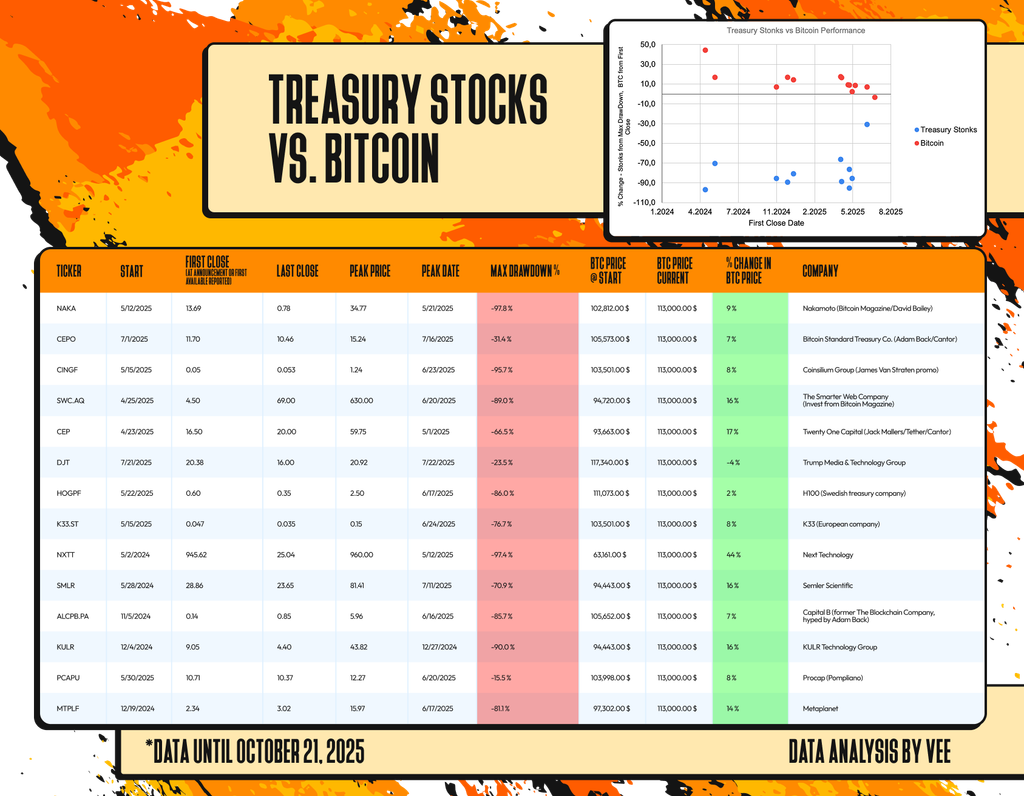
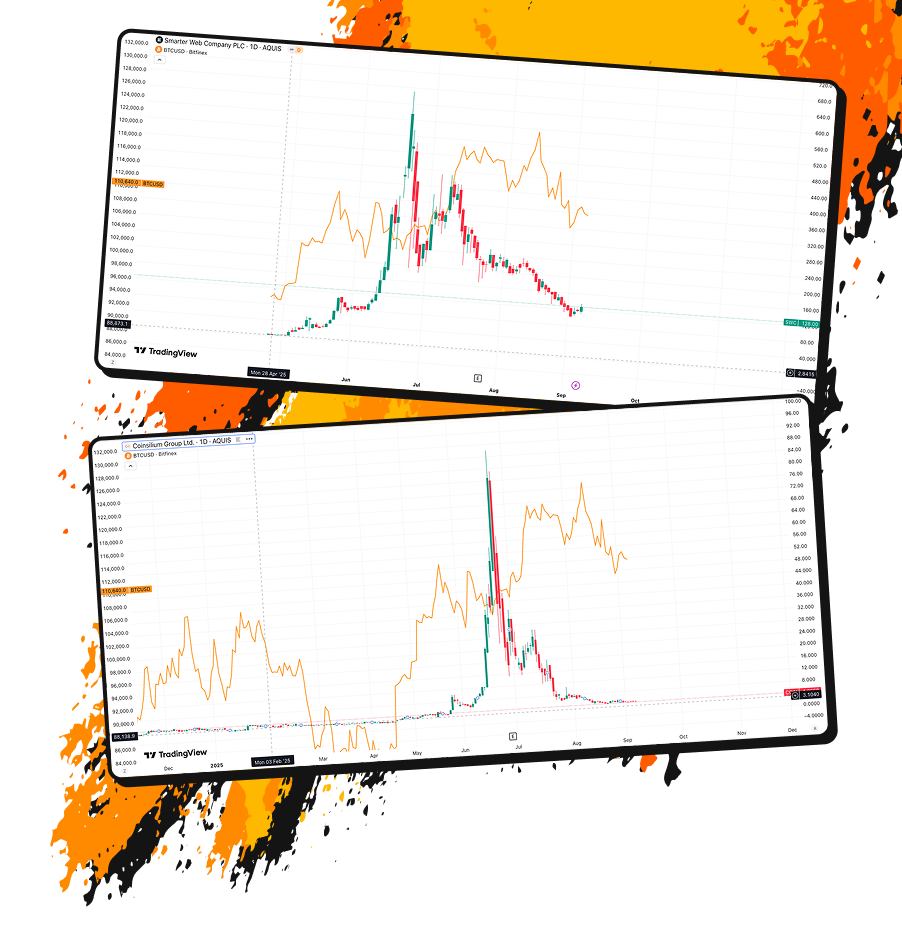
What jumps out? Not a single one has consistently outperformed Bitcoin over their active periods. Twenty One comes closest with a 110% gain since April, but that’s still dwarfed by its 66% drawdown—far worse than Bitcoin’s 13% max dip in 2025. Nakamoto’s story is particularly stark: Announced in May amid fanfare from David Bailey and Bitcoin Magazine, with a merger completed in August involving KindlyMD, shares skyrocketed briefly before falling 95% in three months. Bailey even warned investors of volatility in a letter, essentially saying “exit if you’re not ready.” Coinsilium and Smarter Web followed similar seemingly pump-and-dump patterns: Massive hype-driven surges (Smarter Web up 13,350% by July) followed by brutal reversals, now trading below their Bitcoin holdings’ value per share.
Dollar-Cost Averaging: The Monthly Paycheck Test
Retail investors often save from paychecks, dollar-cost averaging (DCA) into assets. Let’s model a simple scenario: $1,000 monthly invested since each company’s start date versus into Bitcoin. For Nakamoto (May-Sep 2025), you’d have put in $5,000; at current prices, your stock holdings might be worth ~$200 (post-96% wipeout), while Bitcoin DCA would return ~$5,750 (15% gain). Similar math for Coinsilium: ~$250 left versus $5,750 in BTC.
Over 2025 YTD, a $1,000/month DCA into Bitcoin (Jan-Sep: $9,000 total) would be worth ~$10,000 today, a 11% return amid volatility. For Twenty One (best performer), it’d be ~$12,000—but only if you timed the entry perfectly; if you missed the April launch hype, you’re underwater. These stocks’ extreme swings make DCA riskier: One bad month can erase gains, unlike Bitcoin’s steadier (if volatile) trajectory.
Volatility and Risk: Peaks, Troughs, and the Gut Check
Bitcoin’s 2025 max drawdown is about 13%, from August’s $124,457 high to late-month lows around $108,000. That’s tame compared to historical norms (e.g., 30%+ in prior cycles). Treasury stocks show drawdowns of 58%-96%, often in weeks. This isn’t investing or saving, but trading, bordering on gambling for the unprepared. If you’re a retail player without deep pockets or timing skills, these amplified risks can devastate your portfolio. Bitcoin demands patience, but these proxies require near-perfect entry/exit—pure speculation.
Timing Sensitivity: Investing vs. Trading vs. Gambling
Bitcoin rewards long-term holders: Buy and hold through cycles, and history shows outsized returns. These treasuries’ fates, however, depend on announcement timing, market sentiment, and dilution from capital raises. Nakamoto’s 95% plunge coincided with a mild Bitcoin dip, showing decoupling downside. Metaplanet’s 68% drop from June highs outpaced Bitcoin’s 7% pullback, partly due to Japan-specific factors like currency swings. This turns “investing” into trading: You must time hype cycles, or risk missing Bitcoin’s legs up while your proxy lags or crashes.
The Portfolio Pitfall: Picking Winners in a Crowded Field
With dozens of treasuries now (over 145 public/private holders), diversification means building a basket—say, equal weights in our table’s six. But that dilutes returns: While Bitcoin is one asset, your treasury mix might average -30% since mid-2025, missing Bitcoin’s +10%. Wrong picks (e.g., Nakamoto over Twenty One) compound losses. Why complicate things when Bitcoin offers pure exposure without the risk of guesswork?
MSTY and the Income Angle
YieldMax’s MSTY ETF, which sells options on Strategy shares for yield, appeals to income seekers. In 2025, it’s paid $14.37 cumulative dividends per share, yielding ~81% annualized. Total return (price + divs) from Jan is about 12%, versus Bitcoin’s 24%. Shares dropped 48% from January’s $30.69 high to $16.04. Sure, dividends help with credit checks or rentals, but Bitcoin still wins on pure growth. In tax-advantaged accounts like Roth IRAs, direct Bitcoin (via ETFs) avoids MSTY’s complexity and underperformance.
The YieldMax MSTY Option Income Strategy ETF generates income by selling call options, a play that fundamentally caps its potential winnings if Strategy’s stock price rallies significantly. While this strategy offers high monthly distributions, it retains nearly all of the underlying stock’s substantial downside risk, cushioned only by the premiums received. Consequently, the fund presents a critically asymmetric risk/reward profile, trading away significant upside potential for an income stream that may not compensate for major capital losses in a downturn.

The Bottom Line: Stick with Bitcoin
For retail investors, these treasury stocks rarely hold their “outperform Bitcoin” claim. Data shows deeper drawdowns, timing dependency, and selection risks that erode advantages. If you’re saving monthly and seeking long-term growth, direct Bitcoin—via spot ETFs or self-custody—offers better risk-adjusted returns without the corporate drama. Yes, accounts like IRAs might favor stocks for tax reasons, but even there, Bitcoin proxies lag.
TLDR: Nothing beats the original. Buy Bitcoin.
Note from Stackchain Magazine: No Bitcoin (or inferior monies) were exchanged for this article. This article was written by Ratpoison, a simple doggo and Vee ,the Stackchain Queen. You can find Ratpoison on X @RatPoisonaut on Nostr ratpoison@nostrplebs.com. You can find Vee on X @VStackSats on Nostr vee@nostrplebs.com.If you’d like to send Ratpoison some 丰 for the article you can do so via LN ratpoison@getalby.com. If you’d like to send Vee some 丰 for the article you can do so via LN vee@sathoarder.com